Benefits of native app development
Benefits of native app development are: •Outstanding Performance •Dynamic And Intuitive •Security • Access to the Device’s Full Feature Set and more. | Ivorysoft Blog

Benefits of native app development
To survive in pandemic times or outshine competitors, businesses feel pressure to launch apps at speed. This makes them opt for ready-made solutions like hybrid or multi-platform ones. Unfortunately, companies stumble upon real challenges in mobile app development as these types cannot meet the business's specific needs.
For example, hybrid apps cannot boast solid security, seamless performance on mobile devices, and impeccable user experience. The issue gives room for native applications to outshine their counterparts.
Forbes states that the native mobile app development is trendy this year amongst such industries as fintech, banking, multimedia products, and other domains. The reason is clear as day: they need to increase the customer satisfaction rate and, this way, boost customer loyalty and brand awareness.
Now, what is it exactly, and how can entrepreneurs benefit from it? Let’s take a closer look.
What is Native Mobile App Development?
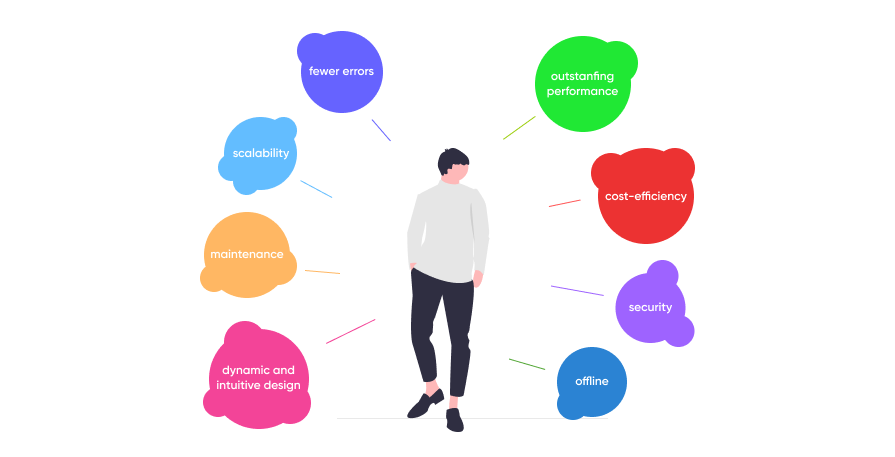
Steve runs a B2C planning firm specialized in providing wealth management and advisory. Now, they are about to launch a budgeting app. It is supposed to help users track personal finances to improve financial health. Users will need to put in such data as incomes, savings, expenses, debt payoffs, and investing.
Besides, the team decided to integrate interactive tutorials to shorten the learning curve. All of that makes the product’s infrastructure multilayered and complex. Since the app also needs to be super secure as it deals with users’ sensitive data, going native becomes a no-brainer for Steve.
So, what does native mobile app development suggest?
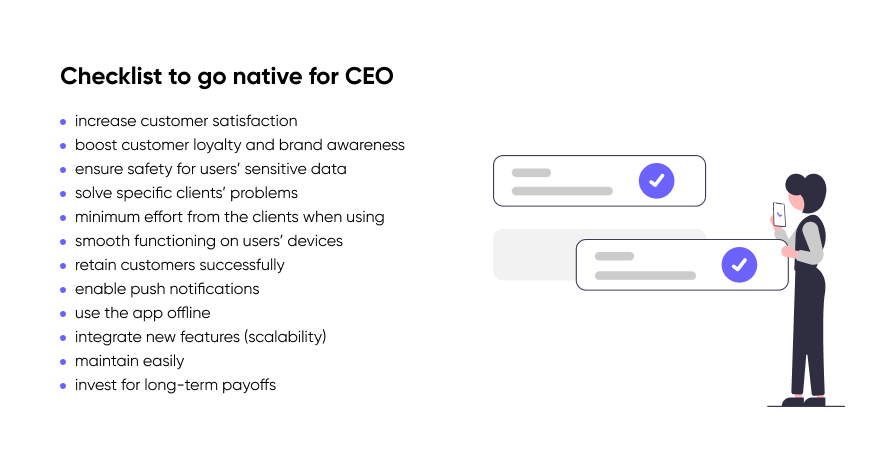
From a business owner’s perspective, it’s an idea implemented in a mobile app that solves the clients’ problems. The more explicit they are, the more the native approach makes sense. Herewith, such apps should require minimum effort from the clients and feel like home with their devices.
From a technical point of view, they are tailored exclusively to different mobile operating systems. Thus, for Android and iOS platforms, two separate teams are involved. Moreover, developers need to consider specified guidelines peculiar to a specific operating system. They also secure specific tools, SDK, and interface components provided by OS providers (Apple, Google, Microsoft).
Last but not least, each operating system suggests a separate programming language. Thus, developers need to use Swift or Objective-C if they intend to build native mobile apps for iOS. These programming languages won’t work for Android. Vice versa, Android developers, write in Java or Kotlin that are useless for iOS.
As we’ve figured out what this type of app development is, let’s get busy with understanding how they behave on a device.
How Native Apps Work
To get a clear idea of how they work, let’s get back to Steve’s budgeting software. The company’s clients use mostly iPhone and Samsung devices. Thus, Steve’s teams need to build two native apps for Android and iOS platforms.
But before it, the teams get a software development kit from each platform, comprising code samples, needed tools, libraries, a whitepaper, and instructions. Why? They enable smooth functioning on a device.
Additionally, these apps can fully rely on the device’s hardware and functionality. As a result, the app comes out intuitive and interactive, and users feel comfortable when opening it. It just comes naturally, like breathing, and, in the meantime, such apps reach the goal their business wants them to.
Speaking of goals, what can native apps bring to the table of any business? Keep on reading.
Benefits of Native Mobile App Development
Native apps are just the thing for those businesses that need device-specific features. They would allow clients to enjoy the service provided to the fullest. Besides, they deliver a greater user experience, which has an impact on successful customer retention. Let’s regard other undeniable native app benefits.
Outstanding Performance
We’ve already discovered that native apps by nature are optimized for a concrete platform. They are compiled using the platform’s core programming language and APIs. Thus, apps get complete hardware and OS support and come out more efficient, responsive, and fast. The load time is quick as all the components are already there on the device. Speed is key when it’s about customer satisfaction, and compared to other approaches, a native one is a “speed destination”.
More Dynamic And Intuitive
Each particular mobile platform contains unique UI/UX rules. The developers are obliged to stick to them, which makes native apps look like they came with a device by default. Since the layout and operations necessary to perform manipulations are familiar to users, it takes no effort to interact with the app. Thus, they don’t have to beat their brains with where to find the menu or how to get to the support field. These factors add to a more excellent user experience and boost customer loyalty.
Security
Native mobile app development is definitely a go-to approach for Steve as his clients enter personal data like credit card one. Besides, the budgeting app suggests synchronization with credit card credentials to track online purchases. So, how can this kind of apps help here?
First and foremost, they are shielded by multiple layers of an operating system, and only official, reliable APIs are used here. It’s a game-changer as, in this case, security is not entrusted to third-party systems whose reliability is questionable. Additionally, native apps enable embedded certification and built-in 2-factor authentication.
Access to the Device’s Full Feature Set
As native apps are created for a particular platform, they are authorized to ‘exploit’ software and the features of the operating system. Thus, the device’s microphone, camera, GPS, and other features can serve the apps’ needs. This makes them run faster, which definitely makes users happier.
Push notifications are one of the native app benefits, for sure. They add value to people and keep them always interested in software and the service provided. Technically, push notifications pass across the iOS Server (APNS) that asks for your app bundle ID, and the same principle works with Google’s Cloud Messaging (GCM).
Have Fewer Errors During Development
The hybrid type suggests that different systems are involved. They are more complex, intertwined, and tightly coupled, which creates dependencies and, consequently more bugs. Native apps, instead, suggest fewer dependencies since they do not depend on cross-platform tools.
This problem becomes critical when Android and iOS release updates. Since the new SDK of native apps is absolutely available to the team, they can easily adopt the latest improvements. Thus, users of native apps get quick access to novel features should they have just updated the operating system.
In the case scenario with hybrid apps, to adopt new features, the team needs to wait until a cross-platform tool supports them. When building a hybrid app, there are added layers that cannot be controlled by developers in most cases. Because of this, bugs show up more often, which affects the users’ loyalty.
Offline Accessibility
Nowadays, people are ‘mobile’ as well. They travel a lot and want their fave apps to be at call. The native mobile app development can address this need. Native apps work without the Internet connection since their content is already stored on a device.
So, if users are somewhere in the mountains, flying in an airplane, or got stuck in a subway or underground tunnel with no connection or weak one - native apps are still accessible.
Scalability
If Steves wants his product to grow, such a feature as scalability can help with that. It implies the increase in traffic, load time, customer base, and the number of updates. The app’s architecture can handle it without any significant modifications to the base.
For cross-platform apps, there’s a need to take care of both Android and iOS users. However, it’s pretty cumbersome to scale since the teams need to ensure flawless performance on all the platforms and prevent crashes as users ‘flood’ the app.
Native apps are made for Android users or iOS ones. Hence, the teams tackle scalability easily as they have more ways to break data flow. In the meantime, such apps are more likely to evolve as they progressively exploit the actual hardware more than cross-platform ones. This drastically minimizes the limitations for potential buildup.
Cost
Having two or more teams might seem super costly for the company’s owner. Actually, it is. Yet, the native mobile app development does pay off in the long run as native apps stand out for a way better customer experience. It contributes to the customer base increase and guarantees successful customer retention.
Some companies first develop a hybrid type and then migrate to native as they figure out the key role of customer satisfaction for the business. Native apps require a more significant investment, but it is a consequent extension to the brand and its services. Thus, other types might ruin the whole image due to functional limits.
Maintenance
What makes maintenance one of the main native app benefits? As we’ve already discovered, bugs are less likely to appear, and updates are adopted smoothly and without significant time gaps.
If looking at this from another angle, native apps are served by separate teams. Each zooms in closely on this or that platform and brings its full expertise to problem-solving on it. Again, it does make users happy and satisfied with the service provided.
Final thoughts
Going mobile is a natural step forward for many businesses that want to survive in the industry. Going native is a go-to solution if leading the pack is a number one goal. Nowadays, a successful customer experience defines how many users will come and stay. And that’s where other types cannot beat native mobile app development.
Native apps hit home with users who already know how the platform works, perform fast and well, and allow adding new features without significant system stagnation. They are more secure, and users can open them anywhere and anytime. Finally, a native approach is more rewarding as it offers more value to the company’s hero - a customer.
