Top 6 Real Challenges in Mobile App Development in 2022
The Real Challenges in Mobile App Development are: •User needs definition •Market evaluation •Financing •Dev technology selection and more. | Ivorysoft Blog

Real Challenges in Mobile App Development
Smartphones are a big part of our reality. On average, consumers spend more time on their phones than browsing the Internet from a PC or other devices. This is probably why global consumer mobile spending might reach $270B by 2025. So, one of the fundamental challenges in mobile development is to make people spend even more time glued to their screens.
When asked how much time you spend on your phone daily, about 46% of US citizens state that it’s approximately 5-6 hours. Browsing the Internet from a mobile device is like having coffee on the go; it’s convenient and doesn’t get you distracted.
Users buy more goods when using mobile devices, but they spend more time on a website from a desktop device. On average, the mobile user will stay on a website for 624 seconds, while the desktop user will spend almost twice as much time there.
Despite mobile development being as popular as it is, there are some real challenges in mobile app development that you should know about. So, let’s take a closer look at how to beat them when creating your own mobile application.
The app development challenge of defining user needs
Before your development process takes off, ask yourself what the fundamental reason behind your idea is? If you don’t know why this mobile app has to be developed, you probably should postpone the whole process.
Why is it so important? Without a strong definition of your target audience and their needs, you’re about to waste time and money without reaching the desired results. About $37 billion are wasted on failed ads annually due to the incorrect identification of the target audience. If you don’t know those people, you won’t engage them. And if you won’t engage them, they’ll never buy what you sell.
Your mobile application might have the best design, user-friendly interface, and all kinds of innovative tech implemented, but the crucial thing is why it exists.
To overcome this challenge, you should look more closely at the people who buy your products or services. What are their interests, professions, what gender they are, and what are their hobbies?
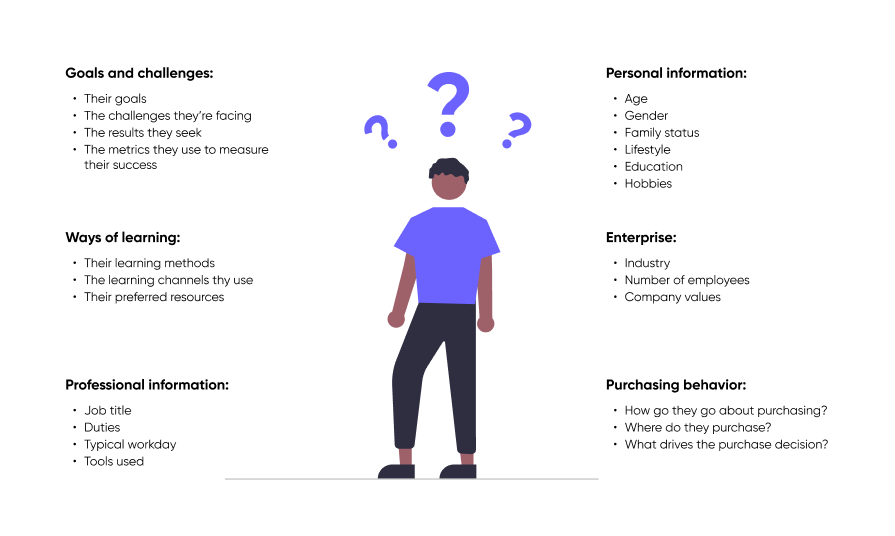
Answering a few simple questions might help a lot in understanding your users’ needs. As one of the significant challenges in mobile app development, this issue needs special attention.
Evaluating the market is one of the major challenges in mobile development
Market evaluation is a process of finding out whether the market is ready for your business and how attractive it is for you. For example, if you see a certain domain living through a downfall, you may want to reconsider building a startup there or launching an application.
Here are some factors that you should consider when evaluating a market you’d like to enter:
- How high is the demand for your product right now? E.g., Pumpkins in the Halloween season have high demand, while Easter souvenirs do not.
- How big is the market (a.k.a. how many people want your product)? E.g., Scissors for left-handed people is a small market, and mobile RPG games are a big one.
- How unique is your offer? How does its uniqueness play with other factors?
- How much effort do you need to put into that product as soon as it is released? E.g., Once you publish a book, you don’t rewrite it. When you release software, you might need to update it.
- What is your pricing potential? Look at the similar offers on the market and see if you’re satisfied with the prices they have set.
These factors are a simplified version of competitors and market analysis, entry barriers research, etc. All combined, they can be a significant mobile app development challenge since it’s almost impossible to predict how your audience will react to the product.
To overcome this challenge, you can start with a minimal viable product (MVP). It’ll help you see the reaction and acceptance the market gives you and understand which way to evolve or change.
Financing challenge in mobile app development
According to CBInsights, the top-1 reason for a startup failure is running out of budget. This challenge is also more than visible for mobile app development since it can be hard to take everything into account.
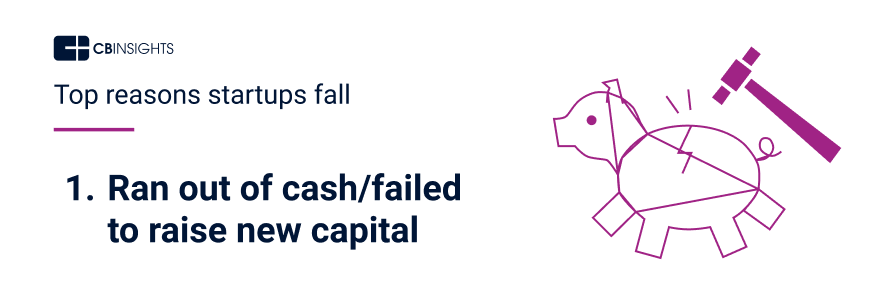
On average, you need to plan the budget accordingly with your development, marketing, maintenance, and additional services costs. It all depends on your idea, and the bigger your ambition is, the harder it gets. For example, CBInsights shares the experience of WOW Air, the European budget airline that ran out of time and wasn’t able to secure additional funding for the company.
To avoid this fate, you can start by carefully planning out the budget and maybe working through a need to pause the development in some cases. You also might start with the high-quality prototype to show it to your investors to secure your funding.
The major app development challenge is choosing the technology
First of all, the real challenge in mobile app development is not finding a tech stack but defining what operating system you’ll launch an app. Android and iOS require different tech knowledge and, in general, different approaches to the development itself.
iOS users are more interested in minimalistic designs when apps for Android often grab users’ attention with vivid colors. However, social media remains a trend for both of them.
And, of course, the OS you choose will influence your overall profits and growth. For example, if you decide to release your app for Android, it’ll likely have more downloads than iOS. Global app downloads 2020 Due to the wide variety of Android devices and the affordability of most of them, Android OS has more market presence. Its market share is around 40%, while iOS falls behind with 16,51%.
However, if you’re looking for a chance to make higher ROI and profits are more important to you than fame, iOS might be a better choice. In 2020, iOS users spent about $47.6 billion on mobile games, compared to Android consumers spending $31B.
You may take the best from both worlds, though. Cross-platform development can open new horizons for your business by keeping a native feel of your application and making it accessible for both Android and iOS.
Choosing is one of the major challenges in mobile app development so, let’s figure out what programming languages you will need for mobile development:
iOS mobile app development:
Objective-C: Apple-supported language for iOS applications development exclusively. It is object-oriented, which means it’s ideal if your idea revolves around data and objects instead of functions. But this language is complex, and a lot of developers are switching to Swift nowadays.
Swift is the 6th most loved programming language according to a Stack Overflow survey.Swift: is a relatively new programming language aimed at creating more but writing less. Since less amount of code is required, everything written on Swift is easier to understand and debug. It leads to fewer mistakes overall and speeds up the development.
Android mobile app development:
Java: is one of the most popular programming languages for mobile development. It’s an open-source language, so it’s capable of giving you the speed and flexibility to create something truly unique. Java is also suitable for cross-platform development, so if you’ll start with it and then decide to scale, you’ll have the perfect opportunity.
Kotlin: an open-source language as well that’s based on Java. If you already have a Java application, developers can transfer it to Kotlin without losing any data. Kotlin allows writing clean APIs and constantly evolves, giving you a chance to encounter fewer malfunctions in the final code.
Due to its universality, C++ can be used for the mobile development of various apps, including games.C++: is one of the most popular programming languages. It’s object-oriented and fast, so it’s capable of giving you a competitive advantage. And it is scalable, so post-release growth and evolution won’t be an issue.
Cross-platform mobile app development:
ReactNative: is a framework that runs in JavaScript. It is used the most for cross-platform development.
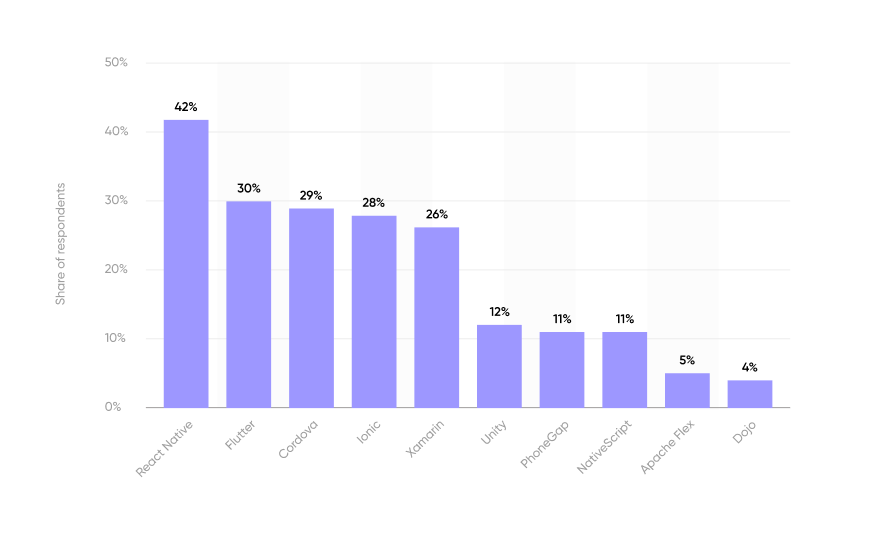 ReactNative allows video processing and rapid prototyping, so it gives you a chance to raise funds before completing an app. It’s proved to be more enterprise-friendly than other frameworks, and if you’re a fan of Agile methodology, ReactNative is what you should work with. Facebook and Instagram are the most known products created with this framework.
Flutter: is a framework that runs in Dart programming language. It was made for fast and dynamic development with a high customization level. It can create powerful applications with a single code-base, so you can have a native feel in both iOS and Android applications you develop.
Xamarin: is a framework for development in C#. It enables developers to share 90% of the code across platforms, making the development quicker and safer. Xamarin allows using third-party code so your developers can implement the existing libraries written in Objective-C or Java. It also has code auto-completion, which helps prevent bugs.
But the tech stack won’t do a job for you, so you need a reliable technical team to work on the project.
Choosing the right team for mobile app development
If you want to ensure that your app functions well, you’ll face one more significant challenge in mobile app development: the team.
It’s always hard to find someone who can bring you high results and be on the same page with you. Each person shares a different view on the project, and maybe this is why about 14% of startups fail due to wrong team choosing, according to CBInsights.
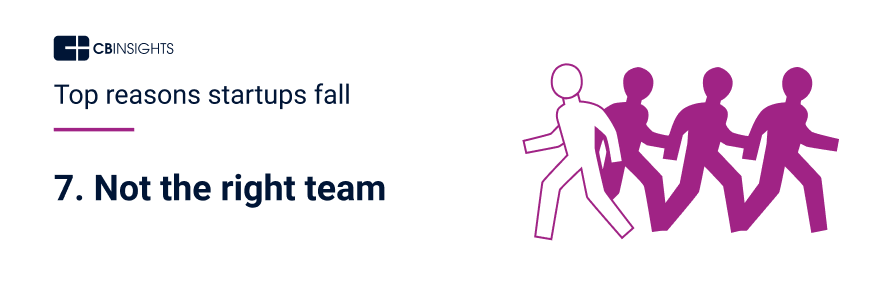
To avoid this bottleneck, pick the ones you work with carefully. Look at their portfolio and experience, and besides their hard skills and tech qualifications, pay attention to their personal qualities. It’d be ideal if your tech team could relate to your target audience. This way, you’ll eliminate communication difficulties.
Technical issues
There are real challenges in mobile app development from a technical point of view as well. We’ve consulted with our developers from IvorySoft to find out what those are and how to fight them.
User-friendly UI|UX For the creation of user-friendly UI|UX, you should remember a few simple rules:
- Be consistent: try to use the same design elements when it’s possible;
- Keep the interface intuitive, so it won’t be challenging to figure out for a new user;
- Simplify the details, minimalism is trendy
- But make sure your interface is user-friendly, so a person could reach a button with one hand if needed or perform the actions you want them to do;
- Be mindful of colors and shapes. Sometimes it’s better to go with the safe but proven route.
Framework and platform knowledge Ensure that people you engage in mobile app development have the knowledge and experience of the chosen tech stack.
Performance and support by older devices It’s vital for Android development since it has a lot of different versions now and they are still widely used. To eliminate this problem, you can ask your developers to use the Android Support Library Security of user data This challenge can be eliminated by data encryption which is considered the safest way for data transfer. You can also implement double authentication to ensure that the user alone has access to their data.
Performance impact on a battery life To optimize your app and prolong battery life, make sure that you implement only crucial features and reduce all unneeded processes. For example, you can use cache data instead of re-downloading data many times in a row. You can also use APIs to help you.
Screen-sizes compatibility
For iOS development, you must ensure that your application runs correctly on all screen variations of Apple devices. Some of them have rectangular displays, and some — rounded corners devices.
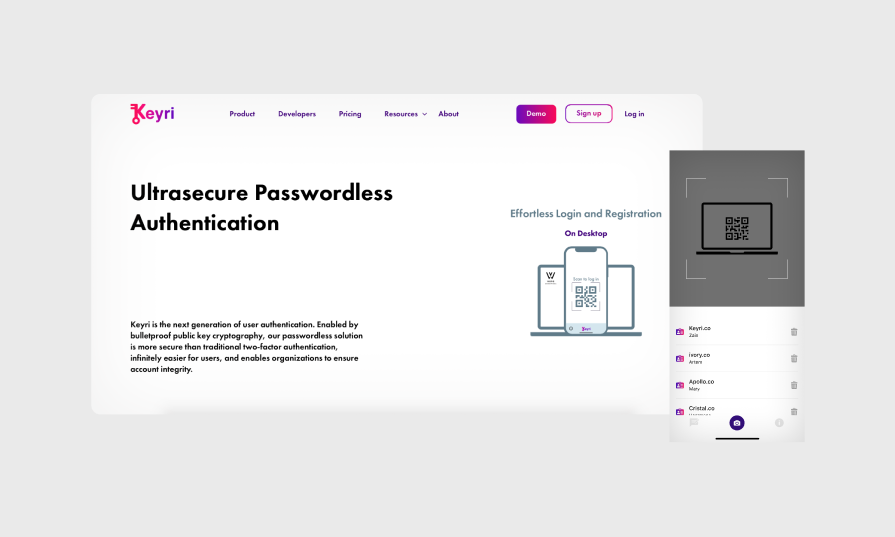 To ensure your app works correctly on each screen, you can use an Auto Layout tool to help your software adapt to resolutions, device orientation, and screen sizes.
Android development is a bit more complicated since this OS supports so many different screens and resolutions. Avoid hard-coding the size and position of the user interface components. This way, if the app resizes to a different screen, it might work well on its own.
The compatibility of OSes
To create a well-functioning and high-quality cross-platform mobile application, you should use the technologies we’ve described above. It’ll allow you to use parts of the native code and ensure that it functions as if it were developed for one OS only.
Java has excellent compatibility with different platforms and can be relatively cost-effective since the development fastens. Popular languages, like Java and C#, also have a big talent pool, so you’ll have plenty of skilled experts to work with.
Cross-platform mobile development might be a challenge only in choosing the best tech stack we mentioned above. In general, it’s a great way to have higher ROI and more downloads by taking the best from both worlds. It’s also highly cost-efficient since you only have one code that you can apply twice.
Security
Data security is also an important challenge in mobile app development. According to IBM, a data breach in 2021 costs about $4.24 million. There are a few ways to eliminate this bottleneck as well.
To secure the transferring data You may encrypt the data, use blockchain or VPN tunnel for direct data transfer. Test the code for security vulnerabilities Encrypt the source code and protect it from any malicious actions and data breaches. Use a File Transfer Protocol (FTP) With it, you can transfer the data only by filling in your unique username and password.
Mobile app promotion
If you’re looking forward to your app being the most popular in app stores, you should consider launching the promotion long before you launch an app itself. Your main goal is to see if the market is ready for the solution you release.
If the market conditions are worse than you thought, attract customers to your application by integrating unique solutions like innovative technologies, AR/VR, or gamification.
This might be longer to implement, so if you aren’t in the mood for waiting, ensure that you have visibility on the Internet. Find the influencers connected to your business domains, launch promo campaigns on social media. It would help if you were seen and to warm up the audience for your release.
You should also consider the search engine optimization strategy for your blog if you’re planning to have one. SEO can help a lot since people often find applications when they’re searching for something specific.
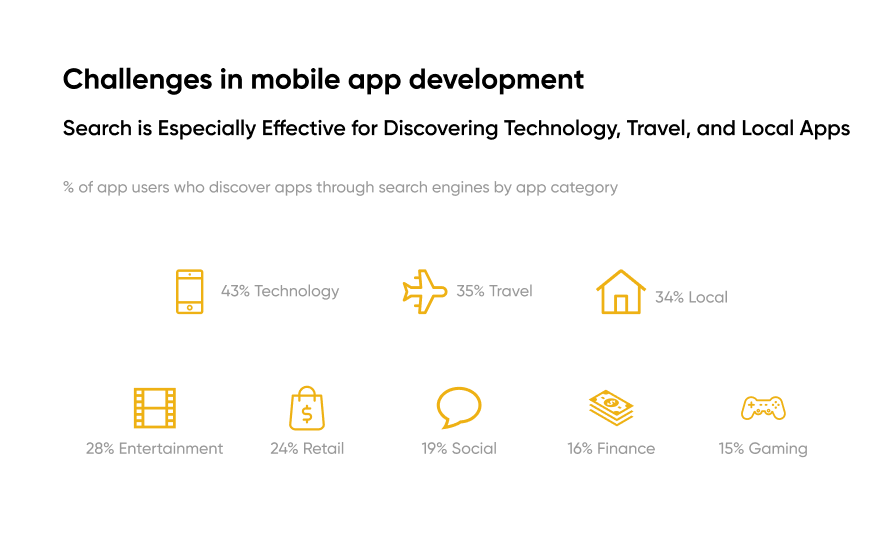
For example, 24% of people find retail applications through a search engine.
In conclusion, we’d like to note that you can still overcome your challenges how complicated they are. With the help of high-skilled professionals or your own, if you believe in what you do, you are already halfway through your way to success.
